Nobody should die that way. Those who witnessed the aftermath of such a death often described it as one of the most horrific things they had ever seen. One of the primary duties of a pathologist is to determine the cause of death, to look beyond the physical shell and uncover the truth of how a life was extinguished.
In the case of Audrey Marie Hilly, the truth was far more sinister than anyone could have imagined.
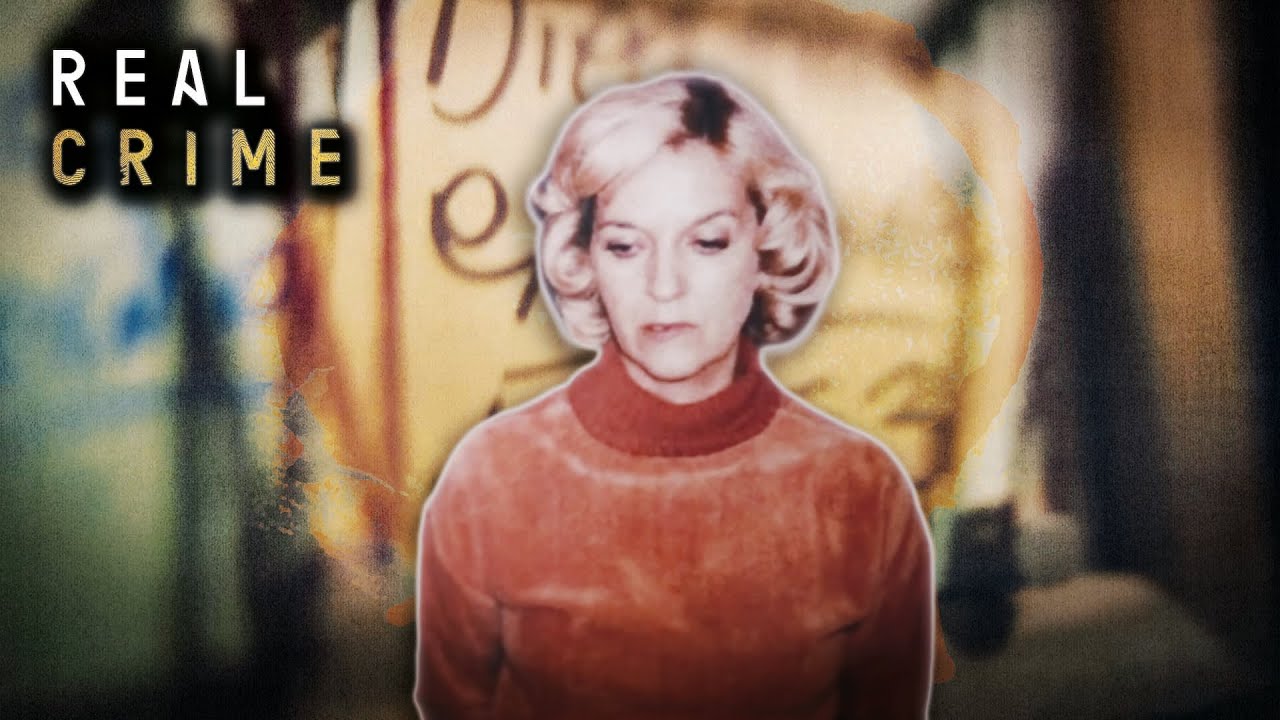 On February 26th, 1987, Audrey Marie Hilly was found muddy and incoherent in a backyard outside Anniston, Alabama. Police Lieutenant Gary Carroll was the last person she ever saw before she passed out. She was found in this yard here.
Her hair was wet with mud and her clothes were wet. He called her name and she opened her eyes and looked at him, and then she rolled her eyes back. As far as he knew, that was her last conscious moment.
She died of hypothermia three hours later.
But Hilly, often referred to as Marie, was no victim. She was attractive, charming, outgoing, and friendly. These were probably the results of being sociopathic, as we now know.
Born Audrey Marie Frasier in 1933, Marie was the only child of Huey and Lucille. The family lived in the mill township of Blue Mountain on the outskirts of Anniston, Alabama, and they doted on Marie. Despite her parents’ modest means, Marie never went without.
On May 8th, 1951, she married her high school sweetheart, Frank Hilly, when he was on leave from the Navy. From all accounts, he was a hard worker and a family man. No one ever heard anybody say anything unkind about him.
Apparently, he was just an average guy. When Marie became pregnant with their first child, Mike, Frank retired from the Navy, and the couple put down roots in Anniston. By 1960, their daughter Carol was born.
While Frank found work in the shipping department of a foundry, Marie became an executive secretary. It wasn’t long before she developed a taste for a lifestyle she had never known. Marie always wanted to be somebody she wasn’t.
She wanted to be wealthy. She wanted to be a socialite. Working as an executive secretary, she probably saw that world and wanted to live in it, but she did not have the financial means to do so.
Moving in the circles of some of the city’s most prominent businessmen, Marie liked to look the part. She was never seen without nice-looking clothes and her hair fixed and done up pretty well.
By the time Mike and Carol were teenagers, the cost of their mother’s expensive taste for high-end clothes and cars had placed a palpable strain on their parents. Frank confided in his son that Marie was having an 𝒶𝒻𝒻𝒶𝒾𝓇. Some of the people she had worked for were very complimentary about her willingness to work long hours.
From what is understood, Frank came home from work one day early and caught her in bed with her boss. While that cannot be proven, it is clear she would rather have her freedom.
Frank had been suffering stomach complaints for years. Poisoners tend to be very stealthy. They are very quiet about what they do.
They plan these things out. In the second week of May 1975, Frank’s health took a dramatic turn. Marie rang her son Mike in Atlanta.
She was in a panic about Frank, who was suffering from more stomach pains and diarrhea, but also disorientation. News of his father’s hallucinations and admission to the hospital prompted Mike to get back to Anniston.
Less than a week later, on Sunday, May 25th, 1975, 45-year-old Frank Hilly died. The official cause was listed as infectious hepatitis. His life insurance policy paid off the mortgage and paid out just over $31,000 to Marie.
By 1977, Lieutenant Gary Carroll had become familiar with the name Marie Hilly. The widow was a regular caller to the Anniston Police Station, reporting burglaries, threatening notes, phone calls, vandalism, and even arson.
But when police traced the source of one of Marie’s strange calls, it came from her own office telephone. Lieutenant Carroll began to wonder about the veracity of Marie’s claims and whether, in fact, she was the author of them. Marie’s neighbor, also a widow with two children, had reported similar events.
But more disturbingly, her boys had experienced persistent stomach complaints since moving in. The two boys stayed sick with stomach illness the whole time they lived there. As soon as they moved away, all that cleared up.
It is believed that she was experimenting with arsenic to see how much anybody could tolerate, giving people small doses just to see how they would react.
Four years after Frank’s death, Marie had used up the life insurance and had fallen behind on her loan repayments. Her son Mike, now married and living in Florida, was receiving stern letters of demand from credit companies. Puzzled and concerned, he paid his mother a visit in Anniston.
After breakfast that morning, he became ill. He experienced vomiting and gastritis-type symptoms. The thought was that she had poisoned him at breakfast that morning.
He was likely never tested for poison, and it is uncertain if he could ever bring himself to admit that possibility.
In 1978, Marie had taken out a new life insurance policy for herself and her daughter Carol. Having graduated from high school, the 19-year-old had started a course at Jacksonville State University and had decided to rent a place of her own. Marie took her shopping for new furniture and wrote out a check for the purchase.
It bounced. In April 1979, Carol was afflicted with exhausting bouts of nausea and vomiting. Despite regular stays in the hospital, her condition only got worse.
The symptoms were severe muscle spasms, seizing of the muscles, particularly in the abdominal wall, gastrointestinal pain, contractions in her arms, blurred sight, tremendous headaches, numbness throughout her body, and an unquenchable thirst. It was a recipe for a torturous day. When Marie visited her daughter in the hospital, she went armed with baby food and a lethal injection.
One of the relatives had walked into the bedroom while Marie had a syringe in her hand, and she told them that the doctors had told her to give Carol some injections.
The relentless pain made Carol despair. A turn which Marie exploited to get her daughter transferred to Carraway Methodist Hospital in Birmingham, 60 miles west of Anniston. In Carol’s instance, they sent her to a psychiatric facility in order to be evaluated.
Hilly had allowed her own daughter to be admitted to the psychiatric ward. But a passing doctor noticed Carol’s fingernails. When you observe the fingernails in individuals that have been 𝓮𝔁𝓹𝓸𝓼𝓮𝓭 to arsenic, particularly over a long period of time, there are little lines or striations that create on the surface of the nails.
This does not happen under any other circumstances. At that point, the doctor knew that something was up, and that more than likely she had been 𝓮𝔁𝓹𝓸𝓼𝓮𝓭 to arsenic.
Tests at University Hospital confirmed that she was indeed suffering from arsenic poisoning. Carol was chronically subjected to arsenic over a period of time, and it had become essentially infused into her cells and organs. The organs began to slowly shut down over a period of time.
When Lieutenant Gary Carroll visited Carol in the hospital, he was shocked by her frail condition. He had seen her before at the house during all the so-called problems they were having. Carol was pitiful when he went to the hospital.
On September 19th, 1979, Audrey Marie Hilly was arrested in Birmingham. The charge was not for trying to murder her daughter, but for check fraud. She was initially arrested on a bad check charge.
 During that time, they had determined that Carol had been poisoned. Frank’s body was exhumed, and it was tested, revealing heavy, heavy arsenic present. On October 9th, 1979, while she was still in custody on fraud charges, Lieutenant Carroll arrested Audrey Marie Hilly for the attempted murder of her daughter.
But the following month, she was released on bail. By the time they had started investigating her background and what was going on with Carol, her bond for the check charge was fairly significant. One of the men she had previously worked for as a secretary posted a cash bond for her, and that is how she got out of jail.
But when Marie’s attorney went to the motel to meet her, she was gone. Instead, a note was left suggesting Hilly had been kidnapped. Another threatening note in similar handwriting appeared at her aunt’s home, which also matched a note found on Marie’s back door in 1977.
Stealing clothes and a car, Hilly was now on the run. Crossing state borders, abandoning her daughter, debts, and the law, she triggered a nationwide manhunt that would ensue for years. Two months later, Audrey Marie Hilly was indicted for first-degree murder.
She went to Florida and lived there a while, met John, and then they got married, moved back to New Hampshire, and lived there for a while. In Florida, the Anniston fugitive adopted a new identity, calling herself Robbie, and met John Homan.
By October, the couple had moved to New Hampshire. There, she fabricated more lies, telling John and her new work colleagues that she had a rare and terminal blood disorder, and a twin sister in Dallas named Terry Martin. She lived there for some period of time, and then told John she had to go to Texas to take care of her sick twin sister.
While in Texas, she changed her appearance. Finally, she called John and told him that Marie had gotten sick while she was there in Texas and had died.
Reinventing herself yet again, this time as her fictional sister Terry, she told John she had donated his wife’s body to science. A few months later, she turned up on John’s doorstep, posing as Terry. John took her in, but work colleagues were less convinced and alerted the authorities.
Hilly’s days as a federal fugitive were numbered. By sheer coincidence, one of her concocted namesakes was on the FBI wanted list. On January 12, 1983, they arrested her.
When Hilly revealed her true identity, her three-year odyssey skirting the authorities was at an end. She was transferred back into the custody of Anniston police. The trial of Audrey Marie Hilly began on May 31st, 1983.
It became a matter of deep interest in the community when they approached trial. One hairdresser told Lieutenant Carroll that he had ruined her business because she didn’t have any customers the week the trial started, as they were all at the courthouse. It was almost surreal.
Extra security was called in.
When the trial started, there was actually a line of people, mostly female and mostly older ladies. The speculation was that not only was there interest in the case itself, but they were down there to hear some of the details that might have been titillating as far as some of the people Marie had worked for. Hilly and her attorney seemed confident that the case against her, being circumstantial, was weak.
Everybody thinks you can’t be convicted on circumstantial evidence. That is not true, but the circumstances have to be so overwhelming as to be convincing beyond a reasonable doubt. In this case, that was true.
They underestimated how much trial preparation would be put in by the district attorney. They underestimated how much evidence Gary Carroll had been able to uncover and produce. The state’s key witnesses, Hilly’s own son and daughter, took the stand and testified against their mother.
She may have thought Carroll would not even testify against her. To lose your parents is one thing. To have one of them try to 𝓀𝒾𝓁𝓁 you is something else.
During the three years her mother had been a fugitive, Carol had moved from denial to a dawning realization that her own mother had murdered her father and had tried to 𝓀𝒾𝓁𝓁 her.
Observers have always wondered what she had counted on to get an acquittal. They never really put on a defense of any kind. They were so overwhelmed with the state’s case.
Marie never took the stand. She never could have stood up to cross-examination. Her story would not have held together.
You could watch her expression become very flat. You could tell she was very disappointed in how the trial was progressing. She knew in her own mind that by the time the trial was over, she was going to be found guilty.
Audrey Marie Hilly received a life sentence for the murder of her husband, Frank Hilly. She was given 20 years for the attempted murder of her daughter, Carol, whose recovery from her mother’s assault was arduous and painful. Carol was just a victim.
It is hard not to have sympathy for what was going on with her, because she had been sick for a while and Marie was apparently progressively poisoning her to make her sick. Many have always thought about her sympathetically and respected her ability to stand up to it and to some degree overcome it, especially since a mother is particularly painful.
Hilly was dispatched to Tutwiler Prison for women, 90 miles south of Anniston. But less than four years into her term, she was granted a three-day furlough to visit her husband, John Homan. Furloughs used to be very common in the prison system.
It is where you get a sort of three-day pass and you have to come back, but they notify the local police that you’ve been released on furlough. It used to be very common when Alabama was more of an agricultural society. If there is any other way to put it, there was honor among thieves at that time.
There is no honor among thieves now.
News of Hilly’s three-day release stunned those acquainted with her case in Anniston. They were amazed that she was allowed to leave. They said that due to her good behavior, no law enforcement was advised that she was out for the weekend.
Regardless, she didn’t show back up when she was supposed to at the prison. She put the con job on the warden. It is hard to imagine why she was released at all.
John and Marie spent a day at an Anniston motel. John left for a few hours. On his return, Marie had vanished.
With a convicted murderer on the loose in the very town she was convicted, those close to the case were nervous. There was concern about it. In fact, they actually called Lieutenant Carroll and had him call his wife to pick up their children from school and bring them home, because nobody knew how vengeful she might be.
It would not have made any sense for her to try to be vengeful toward them, but who knows. She was not insane, but she did not have a rational mind for sure. She was sociopathic.
She played people. Sociopaths are normally that way. They are very friendly, very manipulative.
They read you and use you to their own advantage.
 Marie, it turned out, was heading for her old Blue Mountain home, an area she knew well. It is believed that she panicked. She realized time was running out and she was getting ready to have to go back to prison.
She just didn’t want to go back to prison, and she had no plan whatsoever. She just winged it and played it by ear, setting off on foot. Four days after her daring escape, Audrey Marie Hilly died from exposure.
She was 53.
She was ultimately found on the back patio of a home out in the Blue Mountain area of Anniston, which is the area where she originally grew up. She was semi-conscious. They carried her to the hospital.
She was hypothermic and she died there in the emergency room. Lieutenant Carroll hated the fact that she expired, but he was also relieved that she was found, because he didn’t want to go through another three years of trying to find a ghost.
In Sydney, 1952, Yvonne Fletcher stunned the country when she became the first person in Australia to be convicted of murder by thallium. You expect that mothers will be creating stuff with love, not with poison. Some people who have been poisoned with thallium say that it is rather like opening up your chest, putting a pair of pliers in there and twisting the nerves from side to side.
Poison did give her a feeling that she had some power back in relationships where she was perhaps mostly powerless against these strong men.
The most populated urban area in Australia, inner city Sydney, offered a bleak outlook for residents in the years following World War II. The dynamic of Sydney certainly changed after the war. During the war, women had been out working.
When the men returned from war, it was expected that they would go back to the home and be mostly working in the house. For some women, it was difficult to accept that change, to go from having a work life outside of the home to just being contained within the home.
One of those women was Yvonne Gladys Fletcher. Yvonne was born in 1922 to Harold Bogan, a bootmaker, and his wife, Dorothy. But by the time she was 29, Yvonne was a widow with two children living in the inner city where even rats were still feeling the effects of wartime rations and were known to nibble on the faces of sleeping children.
There was a rat plague, a million rats in 1950 running through the city. The government was interested in dealing with those rats because they were concerned about the disease that rats bring with them.
Highly toxic poisons became readily available at the corner shop. But while easy access to products containing the deadly element thallium helped to control the rodent population, it also had some sinister side effects. Celrat, which was the product of choice, was very, very widely used to try and control this.
It actually led to quite a lot of poisonings, a lot accidental. In fact, between 1948 and 1954, there were at least 100 people treated in hospital in Sydney for thallium poisoning. Not all of the poisonings, however, were accidental.
Some were emerging as murders.
It took police and the authorities some time to work out that thallium was being used. It is wondered how many other people were poisoned. Certainly, the police from that period say that there were other cases that never came to court because they couldn’t get the evidence.
Its more nefarious side is that it forms a clear, colorless solution and it is virtually odorless, colorless, and tasteless. It can be put into food quite readily and it is, in fact, acutely toxic in that form.
A former bottle sorter, 29-year-old Bertram Bluey Henry Fletcher, was employed to lay rat baits around the vermin-infested city. It was very effective. It just became part of the society in those days.
This was the rat poison of choice. But because it was so toxic, so colorless, odorless, and tasteless, it became an ideal homicidal poison. Yvonne met Bertram Bluey Fletcher at a dance.
It must have been very difficult for her as a single mother with two children in a Sydney where there weren’t a lot of options for women to work. She had some family support around her, but it would have been a very, very difficult time for her.
Yvonne was motivated to remarry. The couple did marry in November 1951. But within months, the relationship hadn’t just turned sour, it had turned violent.
She was a young housewife living in Newtown, a working-class suburb of Sydney. She had two kids, and she had a husband who it was alleged was violent in the home. They had a very tumultuous relationship.
Yvonne needed help. She had spoken to the police about what was going on in the home, but at that time the police weren’t very proactive when it came to domestic violence.
She went and saw a public solicitor to see if she could have her husband evicted from her home, and that was apparently listed to go to the police court, but it hadn’t. Nothing had moved very quickly for her in terms of dealing with that situation in the home. With each passing day, Yvonne’s tolerance for the 𝓪𝓫𝓾𝓼𝓮 waned.
During that time, not much is heard about Yvonne’s children. She certainly said to one of her neighbors that her son had been hit by her husband. It seems that she decided to take things into her own hands.
Yvonne Fletcher wanted Bluey out of her house and out of her life. It was only a couple of months after she’d tried to get her husband evicted by the police from her home that he became ill and he started showing all of those classic signs of thallium poisoning. The first thing that is noticeable is gastrointestinal disruption.
So, vomiting, diarrhea, abdominal pain. That tends to pass off relatively quickly and so a lot of people would think that they’ve suffered from a stomach bug or something like that with the gastro.
But Bluey’s bout of gastro didn’t clear. Instead, it aggressively morphed into a more extreme episode of agony as the thallium took effect on his nervous system. About one to three days after that, the thallium starts to get into the central nervous system and that’s when it starts to do some real damage.
It interferes with the nerve transmission. Consequently, the first thing that people notice in this neurological phase is usually burning feet, very, very painful burning feet. It is a neuralgic symptom.
Then they start complaining of numbness, tingling, and then that develops to ataxia. It is an unsteady gait, muscle pain, and this can then lead to muscle paralysis and dementia, and often ultimately cardiorespiratory arrest.
Living in close quarters, Yvonne’s neighbors in the suburb of Newtown couldn’t escape the sounds of anguish emanating from their house. Equally unsettling was Yvonne’s indifference to his plight. Yvonne Fletcher’s neighbors would come in to feed her husband because she’d go out and leave him there alone and they’d hear him calling out for things.
One of them described how he could only get to the toilet on his bottom, dragging himself along the floor because his legs no longer worked. They were paralyzed and he was in such pain he could no longer walk under his own steam. The neighbors were quite shocked and horrified and judgmental towards Yvonne because she wasn’t taking care of her husband who was clearly sick and in need of attendance.
With each drop of rat poison she dealt a blow to her once abusive husband. Previously a victim of Bluey’s brutality, Yvonne was now outdoing his cruelty. Indifferent to his anguish, she dragged out his exasperating pain.
 Finally, on March 10th, Bluey was admitted to the Royal Prince Alfred Hospital unable to walk. Two weeks later, Bertram Bluey Fletcher was dead. The people who lived around her were aware that she was in an unhappy marriage.
They had seen her first husband become more and more frail, more and more ill and were aware of how he had died. Then they saw her second husband becoming more and more frail, more and more ill.
A post-mortem failed to find the cause of Bluey’s death. So doctors sent samples to the government analyst for comprehensive testing. Results showed he was awash with thallium.
To her neighbors, Bluey’s fate was disturbingly familiar. It was almost identical to Yvonne’s first husband. After the second husband died, people became conscious of the fact that the first husband had displayed signs and symptoms that were rather similar to the second husband.
That then cast suspicion as to whether he had in fact died of a natural illness or whether he too had been poisoned with thallium.
The body of Yvonne’s first husband, Desmond Butler, was exhumed. Desmond Butler had also met Yvonne at a dance. In 1943, Butler had been discharged from military service due to a heart disease called dilated cardiomyopathy.
On April 28th, he and Yvonne, then 21, were married. Within three years, the couple were parents to a son and a daughter. Yvonne Fletcher loved to dance, and there was a lot of talk about the fact that she would be out dancing and that she had this blonde hair like a movie star, and that she cared a lot about what she was wearing.
She would speak to men who were not her husband, and she had a life outside of the home. That was criticized because she was a mother with two children, and she should be at home cooking for her husband, looking after the children, looking after the house, not out dancing and having a gay old time as they’d say in the ’40s. But in April 1947, Desmond became ill.
The cause of Desmond’s illness baffled doctors for 15 months. Often it takes time to make the diagnosis of thallium poisoning because you tend to think of these natural diseases.
Indeed, on one occasion when he went to the hospital, they thought he was putting it on, that he wasn’t genuinely ill. That is one of the insidious things about thallium poisoning. It does affect people mentally.
So, they might be crying and carrying on in ways that you wouldn’t expect a big macho man to react in that way. Often the hospital authorities just didn’t take them very seriously. The neurological effects are manifest in a number of ways because it’s affecting nerve transmission.
The dementia and confusion is once again just a manifestation of the fact that nerve transmission is being compromised because the thallium is interfering with potassium.
Although Yvonne’s first marriage seemed happier than her second, according to neighbors, she was as indifferent to the suffering of Desmond Butler as she was to that of Bluey Fletcher. On one occasion when Butler returned from hospital, Yvonne was not even at home to meet him. She was out.
She didn’t want him back in the house. She had told the doctors she didn’t want to look after him. She didn’t want him brought home.
She locked up the house and left. The ambulance officers had to break in to the home to deliver him to his bedroom. Desmond Butler died in a Sydney mental institution on July 29, 1948.
He was 30 years old.
After a coronial inquiry, his death certificate cited natural causes. But a second coronial inquiry followed years after Yvonne’s second husband, Bertram Fletcher, died. Thallium will hang around in the body for quite a long time and it accumulates particularly in the hair.
If you are wanting to look for evidence of thallium poisoning in a living person, but also in a corpse, you can analyze the hair. You can do segmental analysis of the hair, where you take the hair from the tip to the root, divide it up into one-centimeter segments, and analyze each of those segments for thallium. Because the rate at which hair grows is known, around about a centimeter per month, you can then come up with a timeline, an estimated timeline of administration.
Police sent samples of Desmond Butler’s remains to a toxicology laboratory for testing. It found that he, too, had died from thallium poisoning. Yvonne Fletcher was arrested on the 19th of May, 1952, and charged with the murders of her two husbands, Desmond Butler and Bertram Fletcher.
Clearly, murder in any form is diabolical. When it is murder of family members, it is even more diabolical. The family and relatives would have been devastated by the whole thing.
Yvonne Fletcher cried as the charges were read to her at the short hearing that followed her arrest.
What shocked the public most about the thallium poisonings of the late ’40s and early ’50s was the fact that it was women who were the nurturers, the carers. Certainly, the women who were suspected of murder or attempted murder were treated very differently to a man in that situation. For instance, the way they looked, the clothing that they wore, the way they walked was all commented on in the press.
In the case of Yvonne Fletcher, she used to bring a little gilt-edged prayer book into the court with her, and that was something that was commented on in the press.
Fletcher’s case was front-page news, and the press coverage of her trial also had an extraordinary and unexpected consequence, catching a second poisoner, Sydney grandmother Caroline Grills. It was quite interesting how Caroline Grills came to police attention. John Downey, who was one of her victims, was reading the newspaper, and in the newspaper there was the story of Yvonne Fletcher, the young woman who’d poisoned two of her husbands in Newtown.
He began to think, well, maybe, just maybe, someone’s poisoning us. He looked around the family group, and the only person who was the common factor amongst all of the people he knew who had died was Caroline Grills.
The article about Yvonne’s case eventually led to Grills’ arrest. Meanwhile, Yvonne Fletcher’s trial continued, sending whispers through the Newtown community. Neighborhood gossip became witness testimony.
One neighbor testified that Fletcher had told her that her husband, Bluey, had punched her on the nose, and she had lost so much blood she required a transfusion. Yvonne Fletcher was taking revenge on her husbands for some of the beatings that she alleged had happened. Because she wasn’t happy in the home and in the relationships, poison allowed her that power.
Poison did give her a feeling that she had some power back in relationships where she was perhaps mostly powerless against these strong men.
After a one-week trial and a four-hour deliberation, the jury found Yvonne Gladys Fletcher guilty of the murder of her first husband, Desmond Butler. On receiving her sentence, Fletcher collapsed, dropping the prayer book she had carried to court each day. Mr.
Justice Kinsella sentenced her to death. Her sentence was later commuted to life imprisonment. Although she had been charged for the murder of her second husband, Bluey, the case never went to court.
Fletcher was released 15 years later in 1964.
She clearly didn’t make great choices when it came to the men that she dated. By the time she was going through her second marriage, she had become more mature and was certainly looking for help outside of the family circle. She was going to police, she was going to the courts attempting to find a resolution.
The resolution that she came to was horrific. To poison her husband and to watch him slowly decline in great pain. That is a terrible thing.